
Sliding vs Hinged Wardrobe: Which Is Right for Your Home?
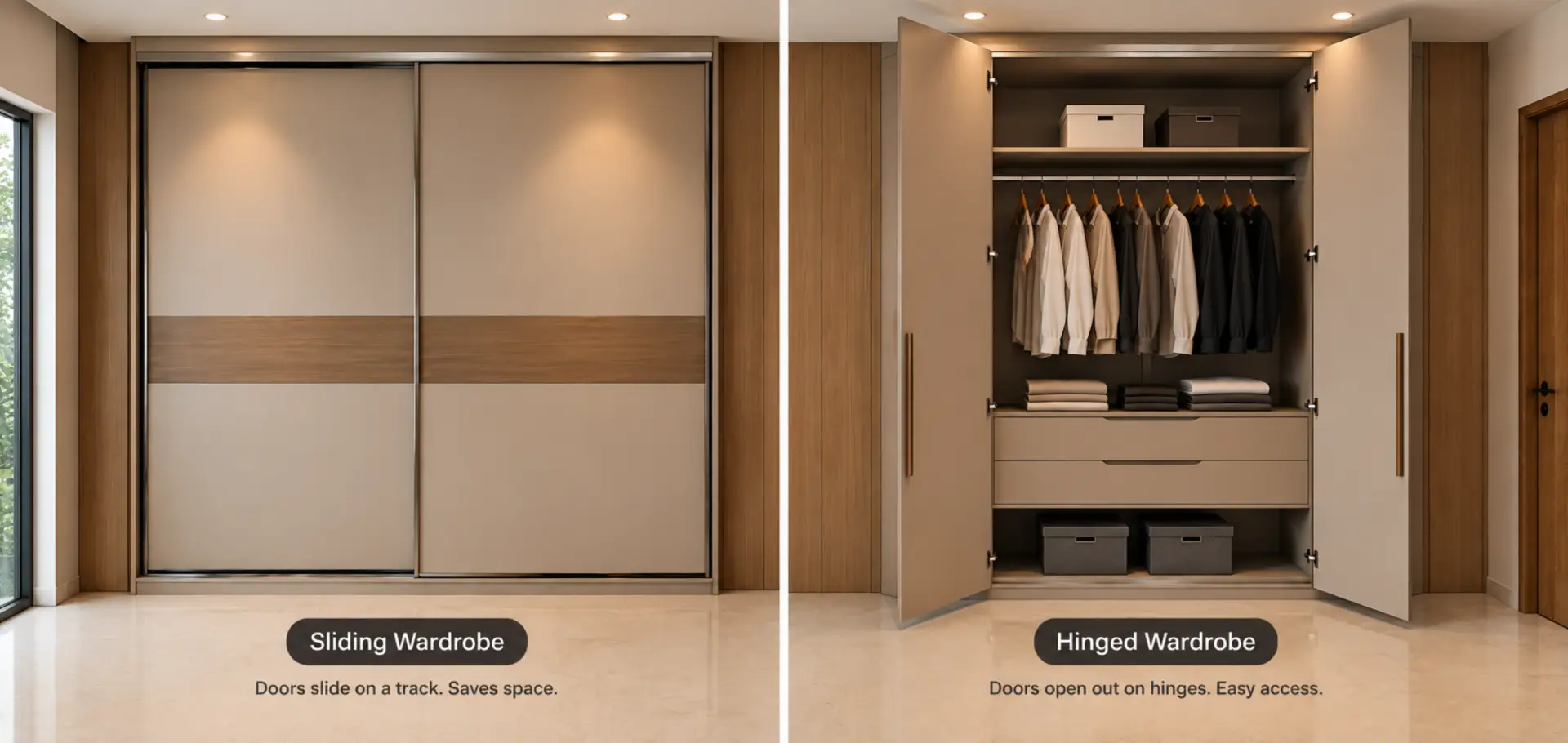
Picking a wardrobe door type feels like a small decision until you’re standing in a narrow bedroom watching a hinged door bang into the bed frame every morning. Or you’re reaching into the back corner of a sliding wardrobe, unable to see what’s behind the door that’s currently closed. Both problems are common, and both are avoidable if you know what you’re choosing between before the carpenter starts work.
This guide is for homeowners in the middle of a bedroom interior fit-out, or anyone replacing an old wardrobe and deciding between sliding and hinged shutters. It covers space requirements, real cost ranges, maintenance, and a decision framework so you can match the wardrobe type to your room rather than to what looked good in a showroom.
In this guide:
• What a sliding wardrobe is and how it works
• What a hinged wardrobe is and how it works
• Key differences between the two, side by side
• Pros and cons of each type
• Space requirements and clearance needed
• Cost comparison
• Maintenance and durability over time
• A step-by-step way to decide which one fits your home
• Five wardrobe design ideas worth considering
• Frequently asked questions
What Is a Sliding Wardrobe?
A sliding wardrobe is a wardrobe with door panels that move horizontally along a top and bottom track instead of swinging open on hinges. The panels overlap each other, so at any given time at least one section of the wardrobe stays closed while another is open.
Sliding wardrobes typically use two, three, or four panels depending on the wardrobe’s width. Materials range from laminate and membrane shutters to glass, lacquered glass, and mirror finishes, which is why sliding wardrobes are often chosen for the mirror-door function alone in bedrooms without a separate dressing mirror.
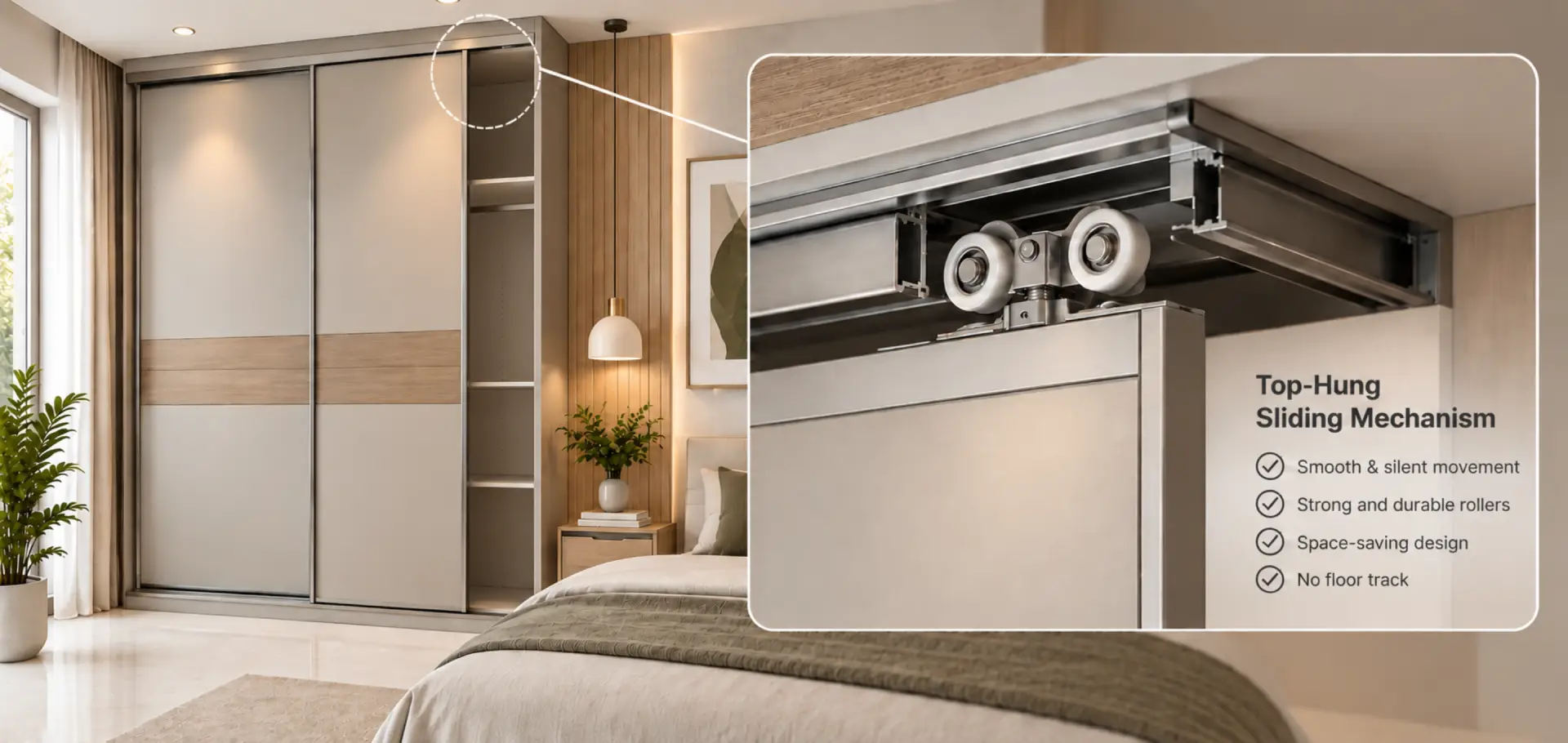
The mechanism relies on a top-hung or bottom-rolling track system. Top-hung tracks (where the door hangs from rollers at the top and a guide pin at the bottom) are the more common choice in Indian homes now, since they don’t collect dust in a floor channel and glide more smoothly over time.
What Is a Hinged Wardrobe?
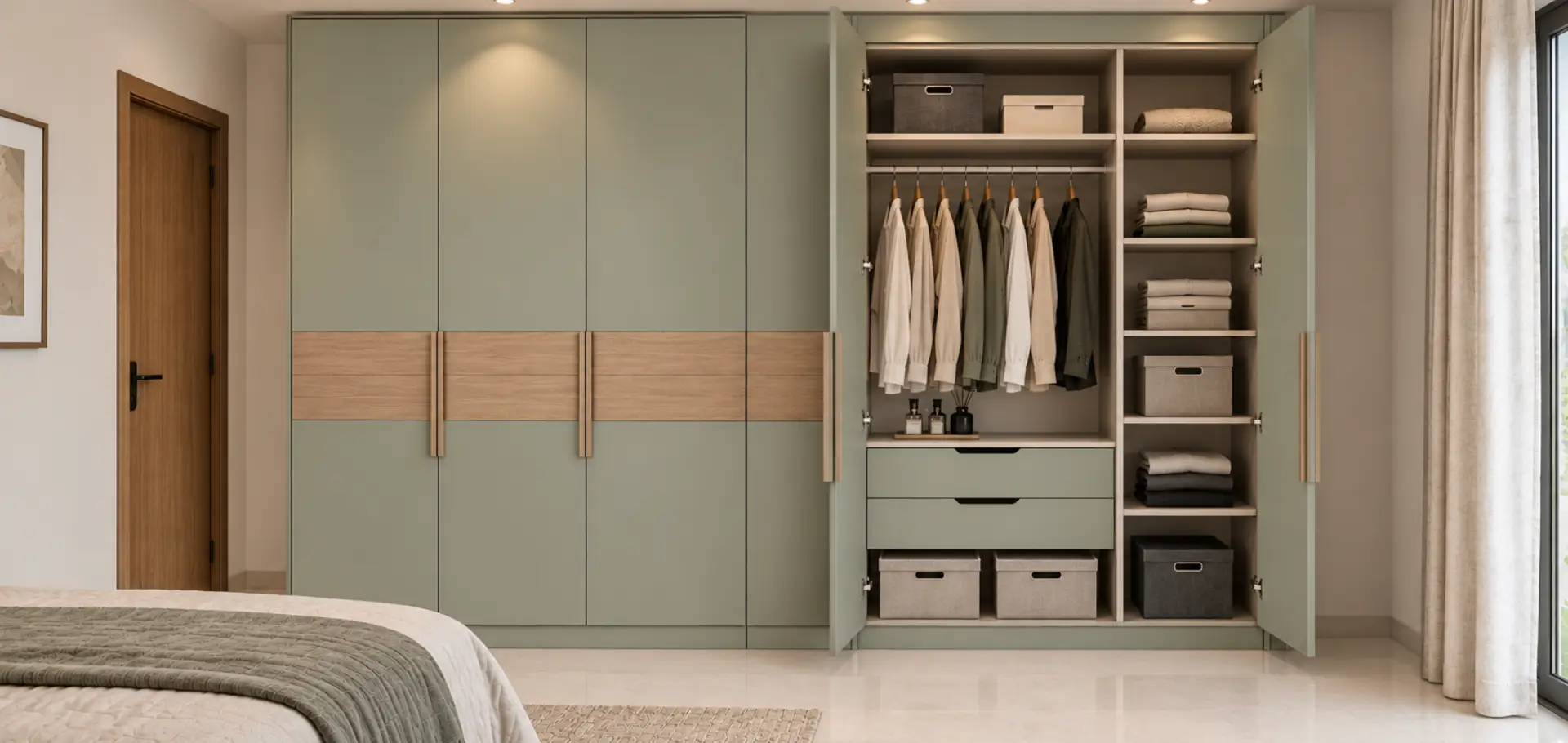
A hinged wardrobe, also called a swing-door or openable wardrobe, uses doors mounted on hinges that swing outward from one side, the same way a room door opens. It’s the traditional wardrobe format and is still the default choice in most modular kitchen and wardrobe catalogues.
Hinged wardrobes can have 2, 3, or 4 shutters depending on width, and each shutter typically spans the full height of the wardrobe. Because the entire door swings open, you see the whole compartment behind it at once, not just the section aligned with an open track.
Sliding Wardrobe vs Hinged Wardrobe: Key Differences
The core difference comes down to how the doors move and how much floor space that movement needs. Everything else, cost, access, mirror integration, follows from that one mechanical difference.
| Factor | Factor Sliding Wardrobe | Hinged Wardrobe |
|---|---|---|
| Factor Door movement | Horizontal, along a track | Swings outward on hinges |
| Floor clearance needed | Minimal (6-8 inches) | 2.5-3.5 feet in front of the door |
| Interior visibility | Only the open section is visible at once | Entire compartment visible when open |
| Typical cost (per sq ft) | 10-20% higher than hinged | Lower baseline cost |
| Mirror integration | Common, doubles as a dressing mirror | Needs a separate mirror panel |
| Best suited for | Small or narrow bedrooms, walkway-adjacent placement | Larger bedrooms, walk-in style layouts |
| Repair complexity | Track and roller replacement needs a technician | Hinge replacement is simple, low cost |
Pros and Cons of Sliding Wardrobes
Advantages
• Needs almost no floor clearance in front, works against a bed or in a walkway
• Doubles as a full-length mirror when fitted with a mirrored shutter
• Gives bedrooms a cleaner, more streamlined look since no door ever juts into the room
• Fewer visible hinges and fittings, which suits a minimalist design brief
Disadvantages
• Only one section is accessible at a time, the rest stays behind a closed panel
• Tracks need periodic cleaning, dust and lint buildup can make the doors stick
• Costs more upfront due to the track hardware and soft-close mechanisms
• A jammed roller can block access to the entire wardrobe until it’s fixed
Pros and Cons of Hinged Wardrobes
Advantages
• Full compartment visible and reachable the moment the door opens
• Lower material and hardware cost compared to sliding systems
• Hinges are inexpensive and easy for any local carpenter to replace
• Wider range of finish and panel options since there’s no track constraint
Disadvantages
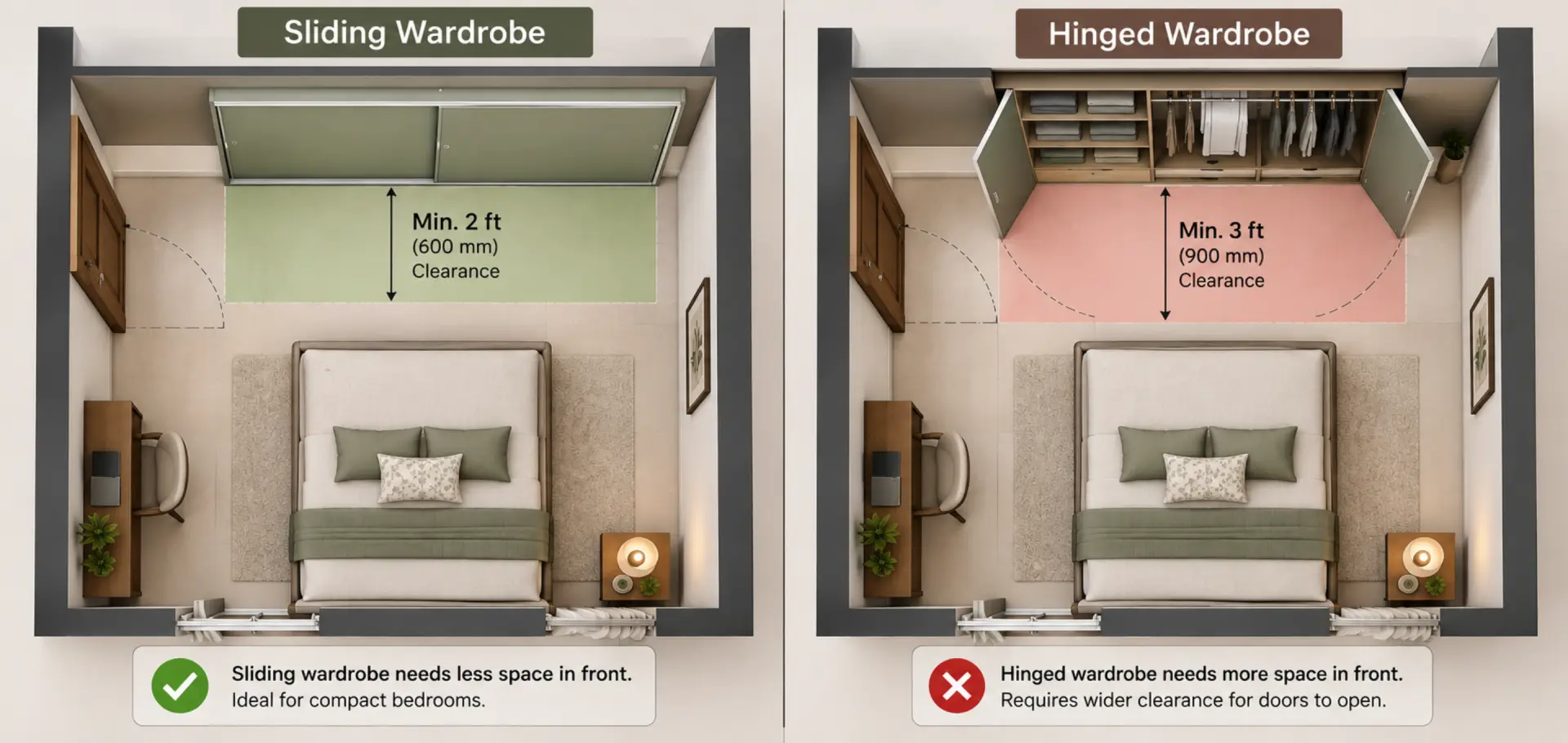
• Needs 2.5 to 3.5 feet of clear floor space for the door swing
• Can collide with a bed, dressing table, or another door in a small room
• Doesn’t offer a built-in mirror function the way sliding shutters do
• Open doors can partially block room lighting or a walking path while in use
Space Requirements: Which Needs More Room?
Clearance is where the decision usually gets made in practice. A hinged wardrobe needs enough open floor in front of it for the door to swing through its full arc, while a sliding wardrobe only needs a shallow gap for the track and handle.
| Room Type | Recommended Wardrobe | Clearance Needed |
|---|---|---|
| Bedroom under 100 sq ft | Sliding | 6-8 inches |
| Bedroom 100-140 sq ft with tight layout | Sliding | 6-8 inches |
| Bedroom over 140 sq ft, standard layout | Either | 6-8 in (sliding) / 2.5-3.5 ft (hinged) |
| Walk-in wardrobe or dressing room | Hinged | 2.5-3.5 feet |
| Wardrobe placed opposite a bed with under 3 ft gap | Sliding | 6-8 inches |
In several 2BHK and 3BHK apartments we’ve fitted out, particularly in newer high-rise apartments where bedroom sizes run smaller than in independent houses, the clearance question alone rules out hinged wardrobes in at least one bedroom before cost even comes up.
Cost Comparison: Sliding vs Hinged Wardrobes
Wardrobe pricing is generally quoted per square foot of shutter area, and it varies by finish, brand, and whether the carpentry is done on-site or through a modular manufacturer. As a general range across the Indian market:
• Laminate finish, hinged: roughly ₹1,100-1,600 per sq ft
• Laminate finish, sliding: roughly ₹1,400-1,900 per sq ft
• Membrane or acrylic finish, hinged: roughly ₹1,600-2,200 per sq ft
• Membrane or acrylic finish, sliding: roughly ₹1,900-2,600 per sq ft
• PU or lacquered glass finish, sliding: roughly ₹2,400-3,200 per sq ft
These ranges vary by manufacturer, hardware brand (Hettich and Hafele fittings cost more than unbranded track systems), and site conditions, so treat them as a starting point for budgeting rather than a fixed quote. The gap between sliding and hinged narrows on larger wardrobes, since the track hardware cost gets spread across more shutter area.
Maintenance and Durability
Hinged wardrobes are easier to maintain over their lifespan. A loose or squeaking hinge is a five-minute fix with a screwdriver, and hinges rarely fail outright, they just loosen with heavy use over years.
Sliding wardrobes need more deliberate upkeep. The bottom track collects dust, hair, and lint, which can make the door drag or come off its guide pin if it’s not cleaned every few months. Rollers on cheaper hardware wear out faster and can be harder to source for repair once a manufacturer discontinues a track model, which is one reason it’s worth choosing a well-known hardware brand at the time of installation rather than after something breaks.
Both types typically last 10-15 years with normal use before a shutter replacement or refinish becomes worth considering, though sliding systems are more sensitive to installation quality. A poorly aligned track shows problems within the first year, while a hinged door installed slightly off will usually still function, just not perfectly flush.
Which One Is Right for Your Home?
There’s no single correct answer, the right wardrobe type depends on four things specific to your room. Work through them in order.
1. Measure the clearance in front of the wardrobe wall
Stand where the wardrobe will go and measure the open floor space in front of it. If it’s under 3 feet, or if a bed, dressing table, or door swing already occupies that space, a sliding wardrobe is close to a requirement, not a preference.
2. Decide if you need a built-in mirror
If your bedroom doesn’t already have a full-length mirror and you don’t want to add one separately, a sliding wardrobe with a mirrored shutter solves both problems in one purchase.
3. Set your budget per shutter type
If cost is the primary constraint and the room has adequate clearance, hinged wardrobes free up 10-20% of the wardrobe budget that can go toward better internal fittings, drawers, pull-out trays, and organisers, instead of door hardware.
4. Think about how you actually use the wardrobe
If you’re someone who lays out multiple outfits at once or needs to see the full compartment while getting ready, hinged doors give that access instantly. If the wardrobe is mostly for folded storage you access section by section, sliding doors won’t feel restrictive.
Five Wardrobe Design Ideas Worth Considering
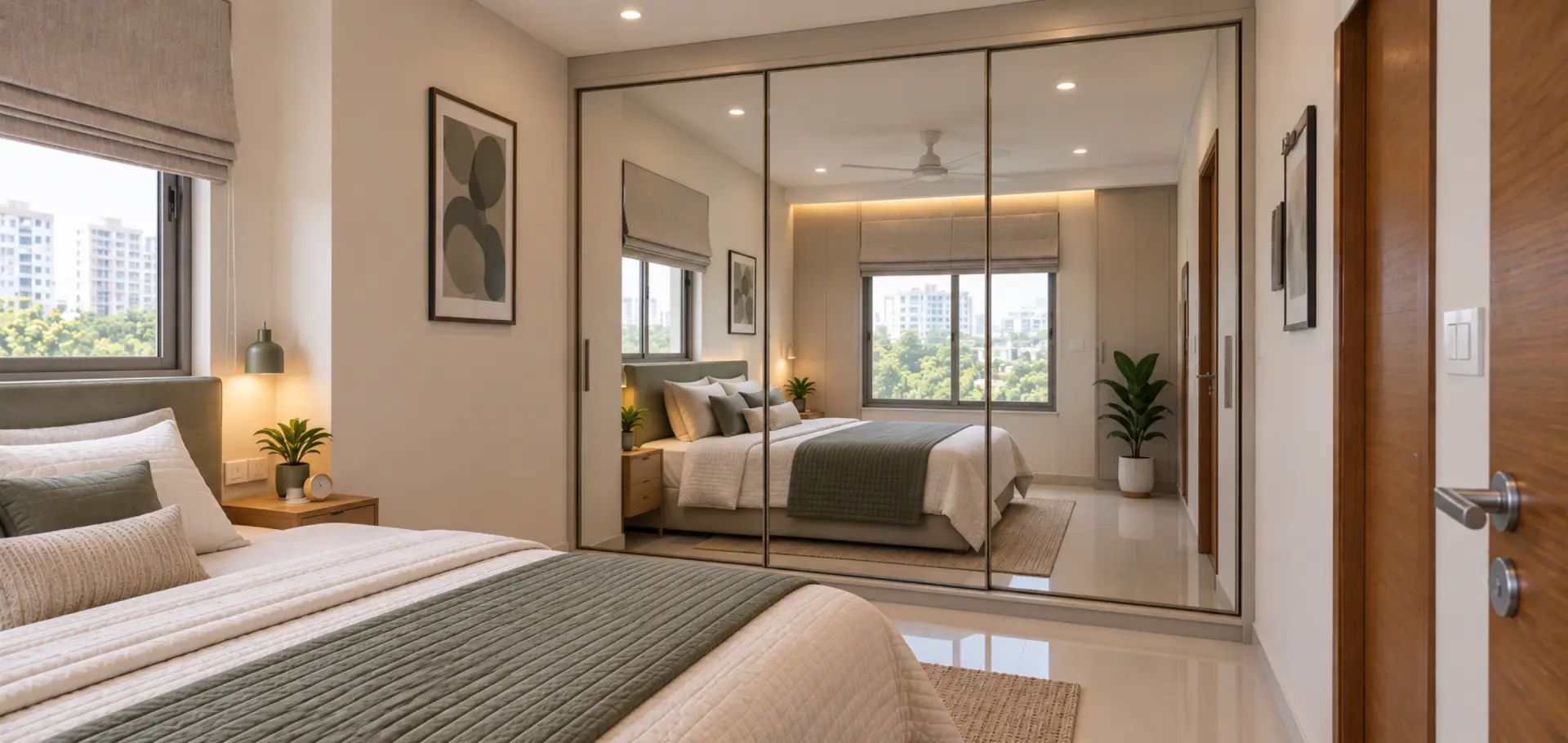
1. Mirrored sliding shutters for a compact bedroom
A full-height mirrored sliding panel on a wardrobe placed along the entry wall makes a small bedroom read larger and removes the need for a separate mirror unit.
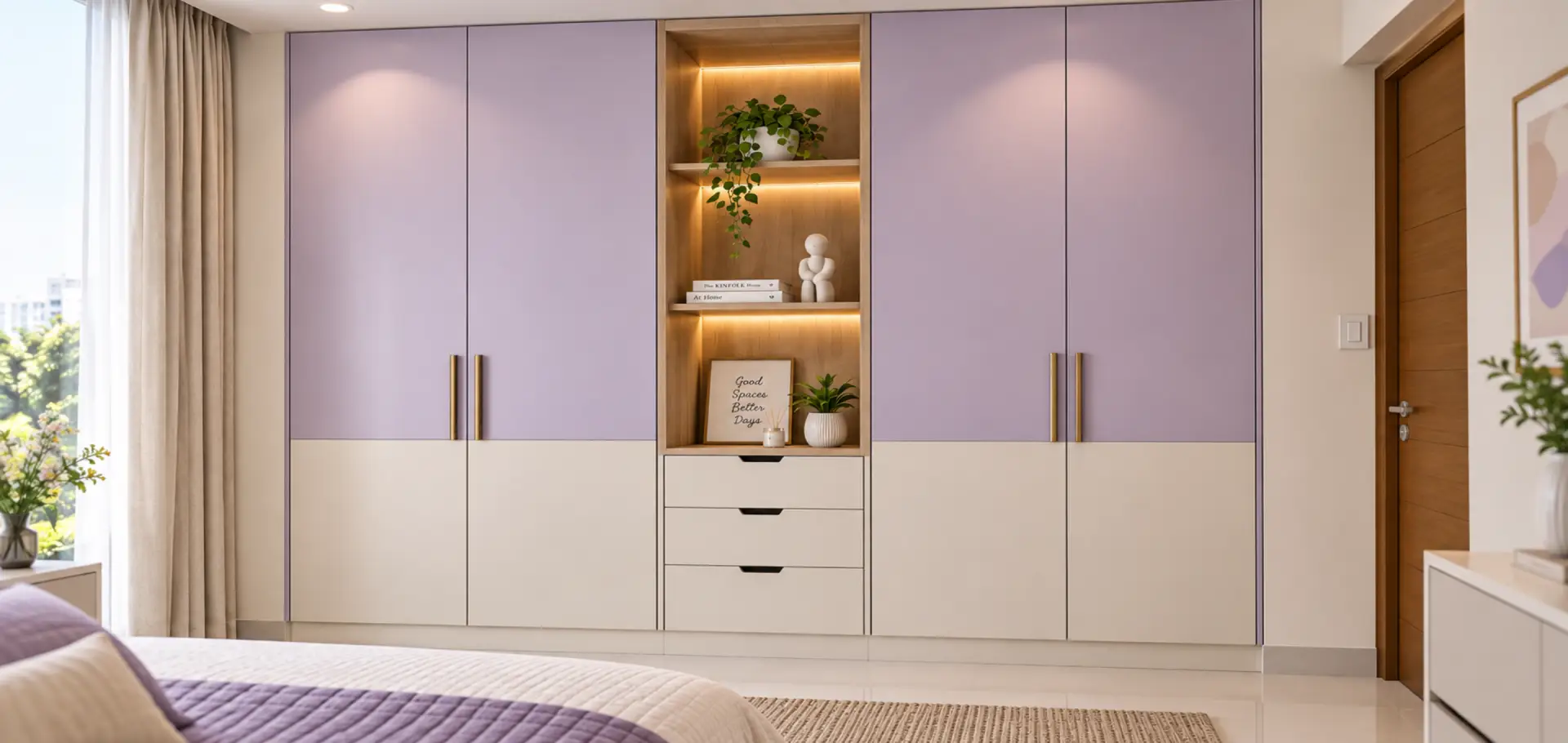
2. Two-tone hinged wardrobe with an open display niche
Combining a laminate finish on the lower shutters with an open shelf or glass-shutter niche at eye level works well in larger bedrooms where hinged doors aren’t a space constraint.
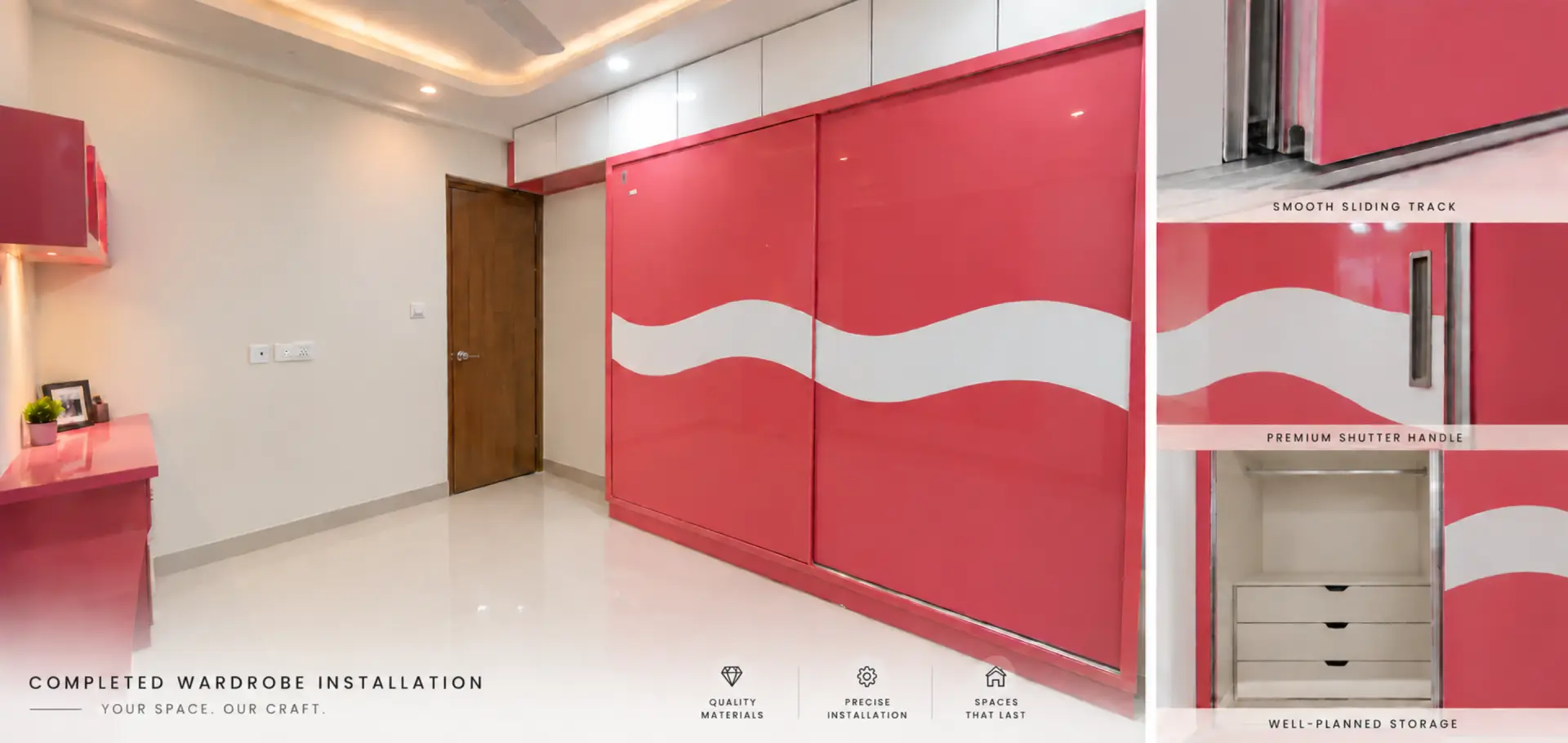
3. Loft-and-base sliding wardrobe for low-ceiling rooms
A sliding wardrobe with a separate loft unit above it maximises vertical storage without needing extra swing clearance at any height, useful in apartments with lower ceiling heights.
4. Walk-in dressing area with hinged shutter cabinets
In homes with a dedicated dressing room or an alcove off the bedroom, hinged shutters on individual cabinet sections give full access without needing a wide track system across the whole run.
5. Handle-less sliding wardrobe with push-to-open mechanism
For a minimalist look, push-to-open sliding shutters remove visible handles entirely, though this adds to the hardware cost and needs slightly firmer maintenance since the mechanism has more moving parts.
Expert Recommendation
Insidez Interiors’ design team recommendation: “We default to sliding wardrobes for bedrooms under 120 sq ft and for any wardrobe placed within 3 feet of a bed or door. For larger bedrooms and walk-in layouts, hinged wardrobes with better internal organisers usually give clients more functional storage for the same budget. The clearance measurement should come before the finish or brand conversation, not after.” This reflects the pattern across the 2BHK and 3BHK interior projects Insidez Interiors has delivered.
Frequently Asked Questions
Are sliding wardrobes more expensive than hinged wardrobes?
Yes, sliding wardrobes typically cost 10-20% more per square foot than hinged wardrobes in the same finish, mainly due to the track, rollers, and soft-close hardware. The gap narrows on wider wardrobes where hardware cost spreads across more shutter area.
Do sliding wardrobes save more space than hinged wardrobes?
Sliding wardrobes save floor space, not storage space. They need only 6-8 inches of clearance in front compared to 2.5-3.5 feet for a hinged door, but the internal storage capacity is comparable for the same wardrobe dimensions.
Which wardrobe type is better for a small bedroom?
Sliding wardrobes generally work better for small bedrooms since they don’t need swing clearance and can be placed close to a bed or narrow walkway without obstruction.
Do sliding wardrobes get stuck or jam over time?
They can, mainly from dust buildup in the track or worn rollers on lower-quality hardware. Cleaning the track every few months and choosing a branded track system reduces this significantly.
Can I get a mirror on a hinged wardrobe door?
Yes, a mirror panel can be fitted onto a hinged shutter, though it’s usually an added cost item rather than a standard feature the way it often is with sliding shutters.
How long do wardrobe tracks and hinges last before needing replacement?
Both typically last 10-15 years with normal daily use. Hinges are cheaper and quicker to replace when they eventually loosen; tracks and rollers cost more and may need a technician, especially on older or discontinued hardware models.
Is a hinged wardrobe better for a walk-in closet?
Yes, in a walk-in or dressing room layout there’s usually enough clearance for the door swing, and hinged doors give full, instant access to the compartment, which suits how walk-in storage is typically used.
Which wardrobe type is easier to repair?
Hinged wardrobes are easier and cheaper to repair. A loose hinge is a simple fix with basic tools, while a sliding wardrobe’s track or roller issue often needs specific replacement parts and more careful adjustment.
Can sliding and hinged doors be combined in the same wardrobe?
Yes, some layouts use sliding shutters for the main wardrobe run and hinged doors for a separate loft or side unit, particularly where the loft has enough clearance and the main body doesn’t.
Conclusion
• Sliding wardrobes need only 6-8 inches of front clearance and suit bedrooms under 120 sq ft or wardrobes placed close to a bed or walkway
• Hinged wardrobes cost 10-20% less on average and give full, instant access to the entire compartment
• Room clearance should be the first factor you check, before finish, brand, or budget
• Both types last 10-15 years with normal use; hinges are cheaper to repair than tracks
• A mix of both, sliding for the main wardrobe and hinged for a loft or side unit, works in some layouts
If you’re planning a bedroom wardrobe and aren’t sure which door type fits your room, Insidez Interiors can measure your space and work out the option that fits both your layout and budget. Reach out for a design consultation to get a wardrobe plan specific to your home.
